
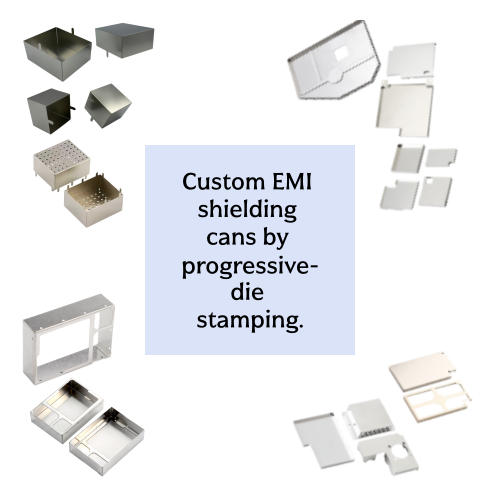
We produce custom EMI shielding cans via progressive‑die stamping, supplying one‑piece, two‑piece and multi‑cavity shield frames for PCB board‑level applications.
Our services include custom logo etching, and all parts comply with RoHS and REACH standards.
We support tape‑and‑reel SMT packaging to meet your mass‑production OEM requirements.
PCB Board‑Level EMI Shielding Can | Precision Stamping · Custom Logo Etching
Electromagnetic interference may cause signal distortion and unstable performance for consumer electronics, communication modules and IoT devices. We produce custom PCB board‑level shielding cans by high‑speed progressive die stamping. Product range includes one‑piece shields, two‑piece frame‑lid shields and multi‑cavity isolation shields. All products are manufactured strictly per‑customer drawings. We also provide custom Permalloy magnetic shielding cans for low‑frequency magnetic‑field attenuation. All units are compatible with SMT pick‑and‑place and reflow soldering process.
Material Options
Nickel‑silver alloy (C7521,C7701): Good solderability, widely used for consumer electronics & wireless modules
Stainless steel: High rigidity and anti‑deformation, ideal for wear‑resistant applications
Permalloy: For low‑frequency magnetic shielding. Soft material, not suitable for SMT reflow; normally assembled by spot‑welding, riveting or snap‑fit.
Key Production Strengths
PCB shielding cans are ultra‑thin precision stampings with strict requirements for flatness, burr control and bending consistency to guarantee high SMT yield.
Ultra‑thin material processing: 0.10‑0.40 mm thin sheet for compact modules
Flatness control: Minimize part warpage to avoid SMT soldering defects
Burr management: Strict edge‑burr control to prevent electrical short‑circuit risk
Stable progressive‑die mass‑production: Capable from small‑batch to high‑volume orders
Multi‑material stamping compatibility: Nickel‑silver, stainless steel and Permalloy
Drawing manufacturability review: Production strictly based on customer‑supplied drawings and 3D files. Before tooling, we check drawings for potential stamping risks and notify customers accordingly. We will not alter customer‑original designs. All features including minimum bend radius, cut‑outs, ventilation holes, castellated feet, locking clips and grounding fingers follow customer final drawings.
Our Production Capabilities
• Material Thickness: 0.10mm‑0.40mm for standard shielding cans; 0.10mm‑0.30mm for Permalloy magnetic shields(stack‑layer option for improved shielding performance) • Dimensional Tolerance: Critical local features can reach ±0.02‑0.05mm. General mass‑production dimensions are maintained within ±0.05 ~ ±0.1mm. All tolerances follow specifications marked on customer drawings. • Core Processes: High‑speed progressive‑die stamping, precision thin‑sheet forming • Custom Structures: One‑piece shield, two‑piece frame‑lid shield, multi‑cavity isolation shield, grounding fingers, locking clips, ventilation holes, castellated solder feet, locating notches. Custom logo and part‑number etching available based on customer artwork. • Surface Finishing: Tin plating, nickel plating, passivation, RoHS & REACH compliant. Custom logo, marking and part‑number etching available per customer artwork. • Packaging: Tape‑and‑reel for automatic SMT assembly, anti‑static tray packaging.
Standard Project Workflow
Customer provides STEP / IGS / DXF / DWG drawings, PCB data and technical specifications.
Drawing manufacturability review within 24 hours, feedback on material selection & process risks.
Tooling & sampling for customer validation.
Progressive‑die tuning for mass‑production.
Volume production with FAI report, dimensional inspection, material & compliance documents.
Custom‑packed shipment with after‑sales support.
FAQ:
Q1 :Difference between standard shield can and Permalloy shield?
A: Nickel‑silver / stainless steel cans suppress high‑frequency EMI. Permalloy works for low‑frequency magnetic‑field shielding. Not suitable for SMT reflow; assembled by spot‑weld, rivet or snap‑fit.
Q2 :Do you provide DFM design modification?
A: We produce strictly according to customer drawings. Before tooling we only check stamping‑related manufacturability risks and give feedback. We will not change customer‑original design. Everything follows customer final drawing.
Q3 :Can shielding cans be supplied in tape‑and‑reel for SMT?
A: Yes. Standard nickel‑silver and stainless‑steel shields support tape‑and‑reel packaging for auto pick‑and‑place machines.
Q4 :What is max reflow temperature for shield cans?
A: Tin‑plated / nickel‑plated nickel‑silver alloy supports standard lead‑free reflow profile. Permalloy parts are not for reflow soldering.
Q5 :Will Permalloy parts be stress‑relieved / annealed after stamping?
A: We only perform stamping forming; annealing / stress‑relief service is not provided. Stamping introduces mechanical stress, magnetic‑shielding performance shall be evaluated by customer.
Q6 :Can you etch logo or part numbers on shielding cans?
A: Yes. Please provide vector artwork (AI / DXF preferred; bitmap files may result in poor edge definition). Etching position and dimension follow customer drawing requirements.


 Send Email
 售前客服
售前客服 WhatsApp